Introduction: Beyond Connectivity
The Internet of Things (IoT) has revolutionized how we interact with the physical world. We have successfully moved from "dumb" objects to "connected" objects. Today, you can turn off your lights from a different continent or check your refrigerator’s temperature via a smartphone app. However, traditional IoT has a limitation: it is largely reactive. It waits for a user command or a simple threshold trigger to act.
The next evolution in this domain is Context-Aware IoT. This paradigm shift moves us from merely "connected" devices to genuinely "intelligent" ones. Context-aware IoT doesn’t just execute commands; it understands the situation—the who, what, where, when, and why—and acts proactively without needing constant human intervention. It is the difference between a thermostat that you adjust via an app, and a thermostat that lowers the temperature automatically because it knows you have just fallen asleep and prefers a cooler room for rest.
What is "Context" in IoT?
To understand Context-Aware IoT, we must first define "context." In computing terms, context refers to any information that can be used to characterize the situation of an entity (a person, place, or object).
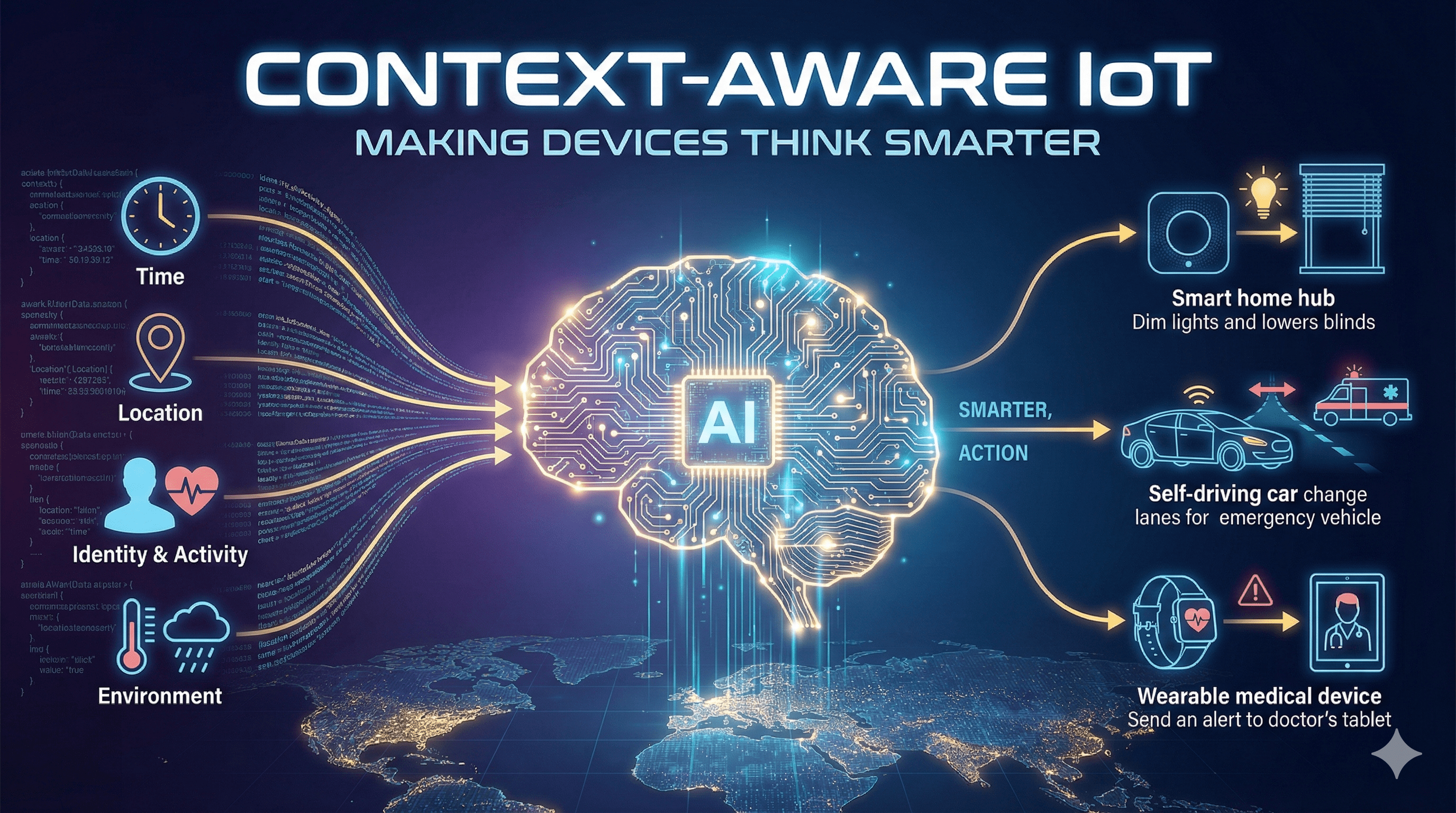
Context involves a fusion of various data points:
Identity: Who is the user? (e.g., A specific driver in a car).
Location: Where is the device? (e.g., GPS coordinates, "Living Room," or "In a Meeting").
Time: What time is it, and what does that imply? (e.g., 2:00 AM usually implies sleep; 9:00 AM usually implies work).
Activity: What is the user doing? (e.g., Running, Driving, Sleeping).
Environment: What are the physical conditions? (e.g., Temperature, Noise level, Light intensity).
When an IoT system can gather, analyze, and act upon this data in real-time, it becomes context-aware.
How It Works: The Sense-Reason-Act Cycle
Context-Aware IoT operates on a complex loop of data processing, often utilizing Edge Computing and Artificial Intelligence (AI).
Sensing (Data Acquisition): This is the foundation. Physical sensors collect raw data. A smartwatch collects heart rate (biometric); a phone collects GPS location (spatial); a smart home hub collects ambient light levels (environmental).
Reasoning (Data Processing & Interpretation): This is where the magic happens. Raw data is useless without interpretation.
Raw Data: Accelerometer shows rapid vertical movement.
Context: The system interprets this movement patterns. Is the user jumping rope, or did they just fall down the stairs?
Machine Learning (ML) algorithms analyze these patterns against historical data to determine the specific "context."
Acting (Adaptation): Based on the reasoning, the system triggers an action. If the system detects a "fall" context for an elderly person, it automatically calls emergency services. If it detects "jumping rope," it simply logs a workout.
Real-World Applications
The transition to context-awareness unlocks potential across various sectors:
1. Smart Homes & Ambient Intelligence Imagine a home that adjusts itself based on your mood and schedule. A context-aware lighting system doesn't just turn on at sunset. It detects that you are sitting on the couch and the TV is on, so it dims the lights to "movie mode." If you move to the desk and open your laptop, it brightens the lights to "focus mode."
2. Intelligent Healthcare (IoMT) In medical fields, context is critical. A standard heart rate monitor alerts a doctor if a patient’s pulse spikes to 120 BPM. However, a context-aware system checks the accelerometer.
Scenario A: Pulse is 120, user is running (GPS/Accelerometer data). Action: No alert (Normal).
Scenario B: Pulse is 120, user is lying in bed (Gyroscope data). Action: Emergency Alert (Possible cardiac event). This reduces false alarms and saves lives.
3. Smart Cities and Traffic Traffic lights today often run on timers. A context-aware traffic system uses computer vision to see that an ambulance is approaching Intersection A. It calculates the speed and distance, turning the lights green specifically for the ambulance while holding cross-traffic, clearing a path in real-time based on the urgency of the situation.
4. Industrial IoT (Industry 4.0) Machines can sense their own wear and tear. Instead of servicing a machine every month (routine), the machine analyzes its own vibration and heat patterns. It recognizes the context of "heavy load" vs. "idle time" and predicts exactly when a part will fail, scheduling maintenance only when necessary.
The Challenges Ahead
While the benefits are immense, Context-Aware IoT faces significant hurdles:
Privacy and Security: To understand context, devices need intimate data—where you are, who you are with, and what you are doing. Securing this data against breaches is paramount.
Complexity and Interoperability: Context often requires data from multiple devices (e.g., a phone, a watch, and a thermostat talking to each other). Ensuring these different brands and protocols communicate seamlessly (Sensor Fusion) is a major engineering challenge.
Power Consumption: Constant sensing and processing drain battery life. Developing low-power AI chips (TinyML) is essential for the viability of these systems.
Conclusion
Context-Aware IoT represents the maturity of the Internet of Things. It shifts the burden of interaction from the human to the machine. We are moving away from a world where we have to tell technology what to do, toward a world where technology anticipates what we need.
By giving devices the ability to understand the world around them, we are not just building smarter gadgets; we are building an intelligent ecosystem that enhances efficiency, safety, and the quality of human life. As sensors become cheaper and AI becomes more efficient, the line between the physical and digital worlds will continue to blur, making our environment more responsive than ever before.